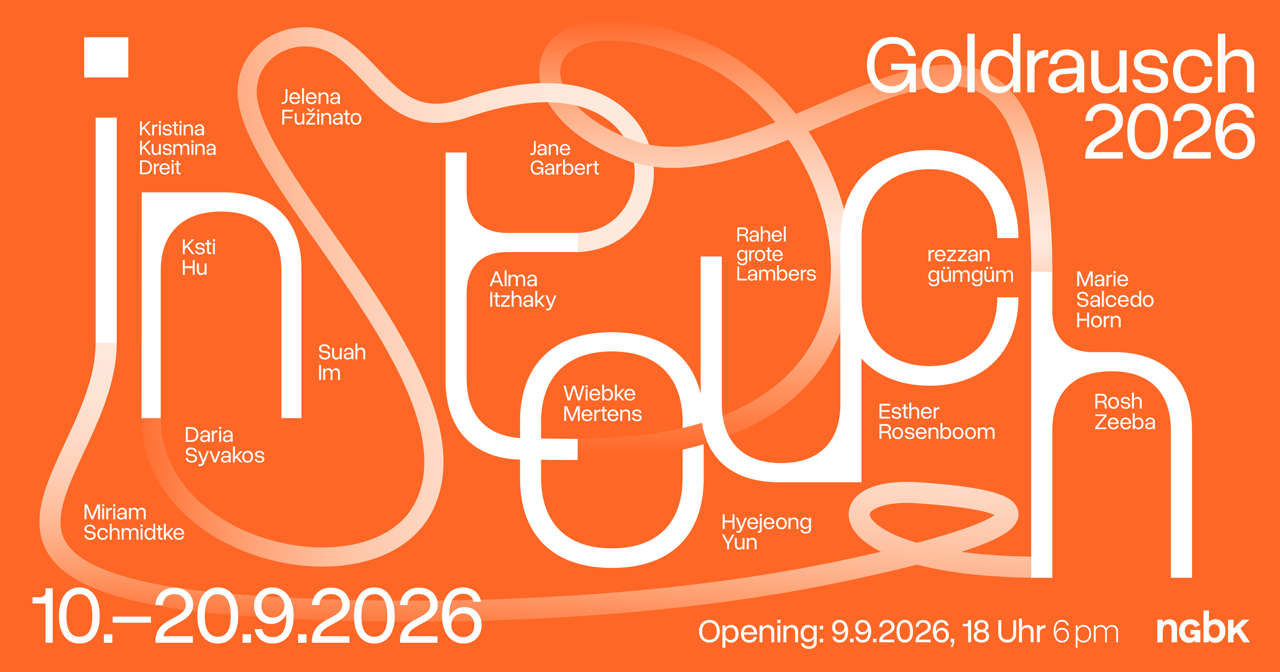
in touch – Goldrausch 2026
Opening
Opening as part of Berlin Art Week 2026 on Wednesday, 9.9., 6:00–10:00 pm
Welcome at 6:30 pm by:
• Sophie Goltz, nGbK Managing Director
Following speeches by:
• Cansel Kiziltepe, Senator for Labour, Social Services, Equality, Integration, Diversity and Anti-Discrimination
• Can Mileva Rastovic, nGbK Chair
• Maj Smoszna, Curator, Goldrausch 2026 exhibition
• Hannah Kruse, Project Director, Goldrausch Künstlerinnenprojekt
Text
How do we stay in touch with sociopolitical reality without losing touch with ourselves? How can we hold on to what we believe in—even when the systems around us prove fragile or hostile?
in touch – Goldrausch 2026 presents new works by the fifteen Goldrausch 2026 fellows working in Berlin. Together, they explore everyday forms of communication, resistance, and intimacy, as well as an often unfulfilled promise: the desire for connection and belonging. The exhibition approaches “touch” as a complement to seeing—as an intimate gesture, a fundamental way of building relationships, and an essential element of the artistic process.
The works depict real and dreamlike places, explore communities, draw on memories and personal stories, or create everyday and imagined objects. At a time when artistic and cultural infrastructures are under pressure, in touch affirms their importance as places of exchange and solidarity. Building lasting support structures is at the core of the Goldrausch Künstlerinnenprojekt: This one-year professional development program promotes public recognition of outstanding artistic practices by women and FLINTA. Since 1989, the program has supported more than 500 women* artists and built a diverse network that strengthens connection, long-term professional development, and public visibility—particularly for underrepresented groups.
Fifteen brochures accompanying the exhibition are available individually or together as a complete catalogue. The exhibition is accompanied by an extensive program of performances and workshops.
Programme
Friday, 11 September
5:30–7:00 pm: Curatorial tour with Maj Smoszna in conversation with Rahel Grote Lambers, Wiebke Mertens, and Esther Rosenboom
7:00–7:30 pm: Performance “The Floating Nose” by Suah Im
Based on her own experiences of commuting between different cities, the artist explores through her body the sensory disorientation, the question “Where am I right now?”, and the fleeting perception of space. During the performance, she closely interacts with the objects that are part of her installation in the exhibition. This is a sensitive attempt by a freely floating body, anchored nowhere, to establish a continuous relationship with an unfamiliar space and to adapt to it.
Saturday, 12 September
12 am–2 pm: Research Workshop “Working from Traces: Artistic Research and the Inaccessible” with Daria Syvakos
This two-hour workshop introduces artistic research methods for working with places that cannot be fully accessed. It starts from a practice, shaped by film, installation, maps and digital environments, with a focus on infrastructures, archives and worldbuilding.
Participants will choose one site or research fragment and work with the material they can access: images, maps, notes, memories, public records or found documents. Through guided exercise, they will build a small research atlas, trace one change over time, mark what remains uncertain, and turn the material into a first artistic sketch.
The workshop is practice-based and intended for 10-12 participants. No technical knowledge is required.
Register here (max. 12 participants)
2–4 pm: Drawing Workshop “Taking a Line for a Walk (in my neighborhood)” with Alma Itzhaky
The workshop will guide participants in creating mental maps of significant places in their lives. Using a simple technique of guided visualization, drawing, and collage, the participants will draw individual mental maps and use them to narrate a memory connected to this
environment. The workshop invites participants to reflect on the connection between drawing and tracing a path on a surface – echoing Paul Klee’s famous saying that a line is a dot that went for a Walk.
The workshop is suitable for families with school-age children (6 and older). Children need to be accompanied by an adult.
Register here (max. 15 participants)
4–5 pm: Performative Intervention “Soil Observations” by Marie Salcedo Horn
The ceramics by Marie Salcedo Horn serve as tools for approaching the floor of the nGbK with multiple senses. The two objects are approximately 50 cm high and mounted on wheels. Visitors can embrace the objects, which resemble funnel-like toys, and push them through the space in order to listen to the floor and the site, or to observe it through a focused gaze. The aim is to explore perceptions of space through the body.
Register here (max. 10 participants)
Sunday, 13 September
5–5.30 pm: Performance “33L of Pain” by Ksti Hu & Vira Pogurskaja
How much landscape can be translated into a body?
When does temperature become political?
When does endurance become a form of translation?
Ksti Hu stands on a block of ice resting on a metal grid and reads a text about invisibility and thermal politics, accompanied by a live composition by Vira Pogurskaja. The melting of the ice forms the temporal structure of the performance and continues after its conclusion as a material process of the installation.
5.30–6 pm: Reading “Manifesto of Post-Phlegmatism” by Miriam Schmidtke
The Manifesto of Post-Phlegmatism celebrates apathy and stagnation in order to reject oppressive demands of capitalism. It’s a meditation on sleep, transforming it from a passive necessity into a political statement. It embraces rest not as a means to recharge for further labor, but as an intentional withdrawal from a system that commodifies human energy. The text draws on sleep as an initiation into a speculative cult of dreamers, a sanctuary for those who seek refuge in the liminal spaces between unconsciousness and the digital ether. Here, sleep is a mystical practice and a rebellion against the hyper- surveillance of techno-capitalism.
6–6.30 pm: Music Concert with Jane Garbert & Adriano Redoglia
Alongside her artistic practice, Jane Garbert writes and composes her own songs. During Berlin Art Week, she will give an intimate concert on the occasion of the group exhibition in touch by the Goldrausch Künstlerinnenprogramm. For the first time, she will be accompanied by drummer Adriano Redoglia.
6.30–7 pm: Performance “Druzhba sent from my iPhone II” by Kristina Kusmina Dreit
Druzhba sent from my iPhone engages with the uncanny visual language of Socialist Realism. The work grew out of subtle parallels between Socialist Realist paintings and the gestures and poses found in the artist’s family photographs. Responding to the layered history of the nGbK at Alexanderplatz—housed in a former McDonald’s within a former market hall—the work raises questions around labor, memory, and their representation.
Thursday, 17 September
5–7 pm: Participatory performative action “rehearsing resistance” With rezzan gümgüm
A participatory performative action using red elastic bands, combining a short public walk with a collective game in the park. Participants are invited to join the game after the walk. The work explores how boundaries are not fixed lines, but relational structures that can be stretched, negotiated, and reshaped through collective movement.
Register here (max. 15 participants)
Friday, 18 September
5–7 pm: Poetry Workshop “Land of Balsam” with Hyejeong Yun
The workshop draws on the historical Korean practice of dyeing fingernails with balsam flowers and leaves. Participants are invited to dye their fingertips using balsam leaves grown by the artist Hyejeong Yun in Berlin. While the colour develops slowly on the skin and nails, participants will be guided through a writing session focused on resistance, community, inherited memory, and forms of care. They may write poems, short texts, or fragments in their own languages. The workshop creates a temporary multilingual collective space in which plant-based knowledge, embodied gesture, and collective writing come together.
Register here (max. 15 participants)
Sunday, 20. September
3.30 pm–4 pm: Lecture Performance from the Series “The Builder’s Daughter” by Jelena Fužinato
Drawing from the diaries of the ongoing non-performance series “The Builder’s Daughter”, the artist will present a lecture performance that examines how individuals adapt to conditions shaped by institutions — and how power influences what feels possible, thinkable, or sayable. Working autoethnographically and drawing on decolonial thought, the artist approaches personal experience as a lens through which to examine broader structures of transnational politics, colonial continuities, and institutional exclusion.
4.30 pm–45pm: Performance “How do I re-enter the world” by Rosh Zeeba
What does it take to become visible again? How do I re-enter the world is a new performance by Rosh Zeeba that occupies the space between the lens, the archive, and live presence. Through a slow negotiation of gesture, language, and material legibility, the piece questions how we step out of the background and into the unmediated present.
Visit the exhibition
Duration: 10–20 September 2026
Opening: Wednesday 9 September 2026, 6pm to 10pm (public)
Opening hours:
Tue–Sun 12:00–18:00
Fri 12:00–20:00
Special opening hours for Art Week, September 10–13: 12:00–20:00
Free admission
Goldrausch-Team
Project Director: Hannah Kruse
Teaching Coordinator: Veronika Bartelt
Teaching Assistant & PR: Manon Frugier
Administration & Finance: Antonia Zeljko, Sonja Altmeppen
Set-up: Leopold Landrichter
Press: Barbara Green
Graphic design: Rimini Berlin
Team nGbK
Managing director: Sophie Goltz
Office and member services: Laura Gaertner
Production: Anuschka Gooß
Technical management: Moritz Jekat
Installation team: Emoke Samu, Tibor Horváth, Jo Landt, Valentyn Medvediev, Levente Pavelka, Matthieu Séry, Andrés Felipe Uribe Cárdenas
Events: Jérôme Sklorz
Press: Lutz Breitinger
Communications: Anna Schanowski, Madeleine Stöber
Publications and archive: Hanna Magauer
Logistics and shipping: Hartmut Schulenburg
Finances: Anita Marschner
Accounting: Barbara Jerusalem, Kerstin Karge
Visitor service: Lith Bahlmann, Valentina Berthelon, Alex Booth, Andrés Felipe Uribe Cárdenas, Marcela Sánchez, André Schöne
Office and member services: Laura Gaertner
Production: Anuschka Gooß
Technical management: Moritz Jekat
Installation team: Emoke Samu, Tibor Horváth, Jo Landt, Valentyn Medvediev, Levente Pavelka, Matthieu Séry, Andrés Felipe Uribe Cárdenas
Events: Jérôme Sklorz
Press: Lutz Breitinger
Communications: Anna Schanowski, Madeleine Stöber
Publications and archive: Hanna Magauer
Logistics and shipping: Hartmut Schulenburg
Finances: Anita Marschner
Accounting: Barbara Jerusalem, Kerstin Karge
Visitor service: Lith Bahlmann, Valentina Berthelon, Alex Booth, Andrés Felipe Uribe Cárdenas, Marcela Sánchez, André Schöne